

Low-Carbon Agriculture Market Set to Reach USD 1,719.02 Million by 2032, Led by Asia-Pacific's Largest Market Share
Low-Carbon Agriculture Market
Low-Carbon Agriculture Market surges with precision farming, carbon sequestration & sustainable practices reducing emissions while boosting yields and resilience”
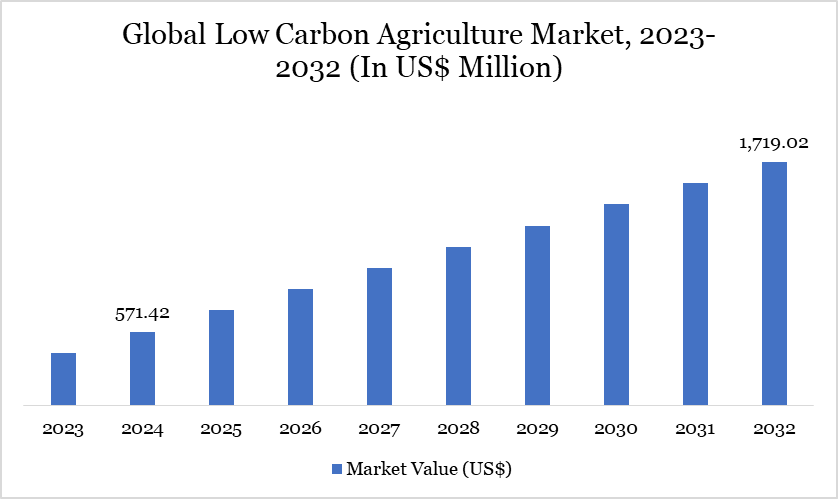
AUSTIN, TX, UNITED STATES, December 2, 2025 /EINPresswire.com/ -- According to DataM Intelligence, the Global Low-Carbon Agriculture Market size is growing from USD571.42 million in 2024 to USD 1,719.02 million by 2032, registering a strong CAGR of 14.76% during 2025–2032.— DataM Intelligence
The market growth is driven by increasing awareness of agriculture’s environmental impact and the urgent need for sustainable farming practices that reduce greenhouse gas emissions. Low-carbon agriculture integrates technologies such as precision farming, organic inputs, carbon sequestration techniques, and renewable energy use to minimize carbon footprints while enhancing productivity.
Government policies and global climate agreements supporting carbon neutrality goals further propel adoption. Additionally, farmers and agribusinesses adopt innovative soil management and energy-efficient practices to meet consumer demand for eco-friendly food products, making low-carbon agriculture a critical component in transforming the agricultural sector toward sustainability.
Download your exclusive sample report today: (corporate email gets priority access): https://www.datamintelligence.com/download-sample/low-carbon-agriculture-market
Key Industry Developments:
- The U.S. carbon farming sector saw accelerated adoption of AI-driven emissions management platforms using predictive algorithms and satellite data, boosting sustainable farming practices and expanding carbon credit trading opportunities driven by policy incentives and corporate commitments.
- Indigo Ag expanded its carbon farming program across 5 million acres in the U.S. Midwest, aiming to generate over 7 million verified carbon credits by 2030, incentivizing regenerative agriculture practices with significant environmental and economic impact.
- JBS and Viva merge to create a global leather giant (Indirect Impact): In December 2025, JBS Couros and Viva Leather merged to form JBS VIVA, a company with over $1 billion in annual revenue. While focused on leather, JBS's significant position in the global food and agriculture supply chain means this large consolidation affects sustainability strategies and material sourcing across their entire operation.
- BE8 acquires another biodiesel plant: In December 2025, BE8, a Brazilian biofuel company, acquired a biodiesel plant in Mato Grosso to increase its total production capacity. This move supports the broader low-carbon energy transition which includes the utilization of agricultural feedstocks.
Market Growth Drivers
-The rising global emphasis on climate change mitigation and agriculture's substantial contribution to greenhouse gas emissions—around 31% of anthropogenic totals—are major forces accelerating low-carbon agriculture adoption. Precision farming technologies, AI-driven emissions management, and satellite monitoring enable farmers to optimize inputs, reduce overuse, and enhance carbon sequestration through practices like no-till farming and agroforestry. Advancements in low-emission fertilizers, bio-additives, and renewable energy integration in farming operations are boosting R&D, with initiatives like carbon credit trading providing economic incentives for sustainable transitions.
-The surge in corporate sustainability commitments and expanding carbon offset markets are broadening the application scope of low-carbon agriculture tools across crop-livestock systems and regenerative practices. Policy support through subsidies, concessional financing like Brazil's LATM, and national climate goals aligns incentives for smallholder farmers to adopt climate-smart techniques that improve yields while cutting methane and nitrous oxide emissions. Regulatory frameworks and consumer demand for eco-friendly food further enhance market readiness for scalable low-carbon solutions.
-The global push toward food security amid projected 70% production increases by 2050, supported by growing integration of IoT, drones, and predictive analytics in farming, strengthens overall market expansion. Investments in projects like U.S. Midwest carbon farming pilots and Japan's precision rice cultivation demonstrate tangible emission reductions of 20-40% alongside economic benefits, positioning low-carbon agriculture as essential for resilient, net-zero agri-food systems.
Segmentation Analysis
-By Practice Type
The market includes agroforestry, conservation tillage/no-till farming, cover cropping, crop rotation, organic farming, precision farming, biochar application, improved livestock management, and nutrient management. These practices focus on reducing greenhouse gas emissions, improving soil health, enhancing carbon sequestration, and optimizing resource use for sustainable productivity.
-By Offering
The market is segmented into products and services. Products include low-emission fertilizers, bio-based crop protection agents, carbon-smart seeds, and precision agriculture tools designed to minimize the carbon footprint of farming operations. Services encompass consulting, carbon credit facilitation, monitoring, and technology integration to support the adoption of low-carbon practices and compliance with regulatory standards.
-By Crop Type
Crop types include cereals & grains, fruits & vegetables, oilseeds & pulses, forage crops, and others. Each segment represents various farming systems where low-carbon solutions are tailored to specific crop needs, maximizing sustainability and yield while reducing emissions.
-By End-User
End-users comprise individual farmers, large-scale commercial farms, agri-businesses/cooperatives, agri-tech companies, carbon credit buyers, government & regulatory bodies, and research institutions. Adoption drivers differ across these groups, ranging from economic incentives and regulatory compliance to innovation in farming technologies and commitment to sustainability goals.
Buy Now & Unlock 360° Market Intelligence: https://www.datamintelligence.com/buy-now-page?report=low-carbon-agriculture-market
Regional Insights:
-In the Low-Carbon Agriculture Market, Asia-Pacific holds the largest market share, driven by increasing climate change concerns, food security needs, and strong regulatory support in key countries such as China, India, Thailand, and Japan. This region has become a strategic hub for investments and initiatives aimed at reducing agricultural emissions and promoting sustainable farming methods.
-North America follows with a significant market share of approximately 34.8% in 2025. This strong position is attributed to a well-established agricultural ecosystem, advanced technology adoption, and supportive government policies that promote sustainable practices. The United States and Canada lead with frameworks encouraging organic farming, precision agriculture, and the use of renewable energy in farming. Investments in carbon farming programs and carbon credit initiatives further strengthen North America's market presence.
-Europe holds a substantial share as well, supported by multiple countries like the UK, Germany, France, Italy, and others actively implementing sustainable agriculture practices and policies. The region benefits from regulatory frameworks and increasing private sector investments focusing on reducing the carbon footprint in agriculture.
Competitive Landscape:
-The Low-Carbon Agriculture Market is highly competitive, with major global players including Yara International, BASF SE, Bayer AG, Syngenta, Nutrien, Viterra, Bunge Ltd, MyEasyFarm, Indigo Ag, Inc., and xFarm Technologies leading the space. These companies focus on innovation in sustainable farming products, including low-emission fertilizers, carbon sequestration technologies, and precision agriculture solutions aimed at reducing the agriculture sector's carbon footprint.
-Key players are heavily investing in research and development to enhance soil health monitoring, bio-based inputs, and IoT-enabled farming platforms that enable predictive emissions management and optimize resource use. Partnerships with governments and agribusinesses play a crucial role in scaling low-carbon farming practices through carbon credit programs, regenerative agriculture techniques, and digital tools for carbon measurement.
-Startups and technology providers such as MyEasyFarm, Indigo Ag, and xFarm Technologies bring innovation through AI-driven farm management solutions and data analytics that empower farmers to implement climate-smart practices efficiently. Collaborative efforts between established companies and emerging players, along with government incentives and corporate sustainability commitments, continue to propel the market towards wider adoption and impactful environmental benefits.
Get Customization in the report as per your requirements: https://www.datamintelligence.com/customize/low-carbon-agriculture-market
Conclusion
The Low-Carbon Agriculture Market is poised for robust expansion, driven by technological innovations and policy support for sustainable practices. As global food demand rises amid climate challenges, it promises enhanced resilience, reduced emissions, and economic benefits for farmers through carbon credits.
Related Reports:
1. Smart Agriculture Market - is expected to reach USD 35.4 million by 2031
2. Precision Agriculture Market - is expected to reach USD 18 billion by 2031
Sai Kiran
DataM Intelligence 4market Research LLP
+1 877-441-4866
email us here
Visit us on social media:
LinkedIn
X
Legal Disclaimer:
EIN Presswire provides this news content "as is" without warranty of any kind. We do not accept any responsibility or liability for the accuracy, content, images, videos, licenses, completeness, legality, or reliability of the information contained in this article. If you have any complaints or copyright issues related to this article, kindly contact the author above.
